
Schwenkbraten on the Open Fire: Germany's Grill Tradition Has Argentine Roots
The best German BBQ recipe has a story most Germans do not know.
Schwenkbraten is Germany's most beloved grilled pork dish. It comes from the Saarland, a region in southwest Germany close to the French border, where summer grilling is taken as seriously as anywhere in the world. The name comes from "schwenken," meaning to swing, because the meat is traditionally cooked on a swinging iron grill suspended over an open wood fire.
But here is the part that surprises most people.
Food historians trace the Schwenkbraten tradition back to German immigrants who settled in Rio Grande do Sul, Brazil, in the 19th century. There, they discovered open-fire meat cooking from the local gaucho culture of South America. The same fire philosophy that gave Argentina its asado tradition gave Germany its Schwenkbraten. They are cousins, separated by an ocean and a century, sharing the same roots. Wikipedia documents this connection between the Saarland's Schwenkgrill tradition and the South American gaucho method.
When you cook Schwenkbraten on an Omberg asado grill, you are not mixing two cultures. You are returning a tradition to the place it came from.

What Makes Schwenkbraten Special
Schwenkbraten is made from pork neck, called Nacken or Schweinehals in German. It is one of the most forgiving cuts you can put on a grill. The neck has a high fat content woven through the muscle, which means it self-bastes during cooking and stays moist even if the heat runs a little high. This makes it ideal for open-fire cooking where temperature control is more art than science.
The marinade is what defines Schwenkbraten. Every family in the Saarland has their own version, passed down and argued over. The base is always onion, garlic, oil, and mustard. Juniper berries are the distinctive ingredient that sets it apart from every other marinated pork recipe in Europe. The marinade needs time. Minimum 24 hours. 48 to 72 hours is what the serious cooks do.
The result, cooked right, is a pork steak with a beautifully charred, spiced crust on the outside and meat that is soft, juicy, and deeply flavoured throughout.
Ingredients
Serves: 4 to 6 people Prep time: 20 minutes plus 24 to 72 hours marinade Cook time: 25 to 35 minutes Difficulty: Easy
For the pork:
- 4 to 6 pork neck steaks, each about 2 to 3 cm thick, approximately 200 to 250 g each
- 2 medium onions, finely sliced
- 4 garlic cloves, crushed
- 3 tablespoons Dijon or German medium-hot mustard
- 5 tablespoons neutral oil, such as sunflower or rapeseed
- 8 juniper berries, lightly crushed
- 1 teaspoon dried thyme
- 1 teaspoon smoked paprika
- 1 teaspoon coarse black pepper
- Half teaspoon coarse sea salt
- 2 bay leaves
For the fire:
- Good hardwood charcoal or quebracho wood
- Chimney starter or natural firelighters
To serve:
- Fresh crusty bread, "Brötchen" or baguette
- German potato salad, warm or cold
- Mustard on the side
- Cold beer or chilled Riesling (see pairing suggestions below)

Instructions
Step 1: Make the Marinade
Mix the sliced onion, crushed garlic, mustard, oil, juniper berries, thyme, smoked paprika, black pepper, salt, and bay leaves together in a large bowl. Stir well until the mustard is fully combined with the oil.
Add the pork neck steaks and turn each one to coat thoroughly. Press the onion slices against the meat so they stay in contact during the marinade.
Cover the bowl with cling film and refrigerate for a minimum of 24 hours. Turn the steaks once halfway through. For the best result, marinate for 48 to 72 hours. The longer the marinade, the deeper the flavour penetrates into the meat.
Step 2: Prepare the Grill
Take the pork out of the refrigerator 45 minutes before cooking. Cold meat on a hot fire creates an uneven cook. Room temperature gives you a better result from the outside in.
Build your fire 45 to 60 minutes before you want to cook. You want a medium to high bed of coals, not an enormous roaring fire. Schwenkbraten is cooked faster than beef ribs or vacio. The goal is a good, strong heat that chars the outside while keeping the inside moist.
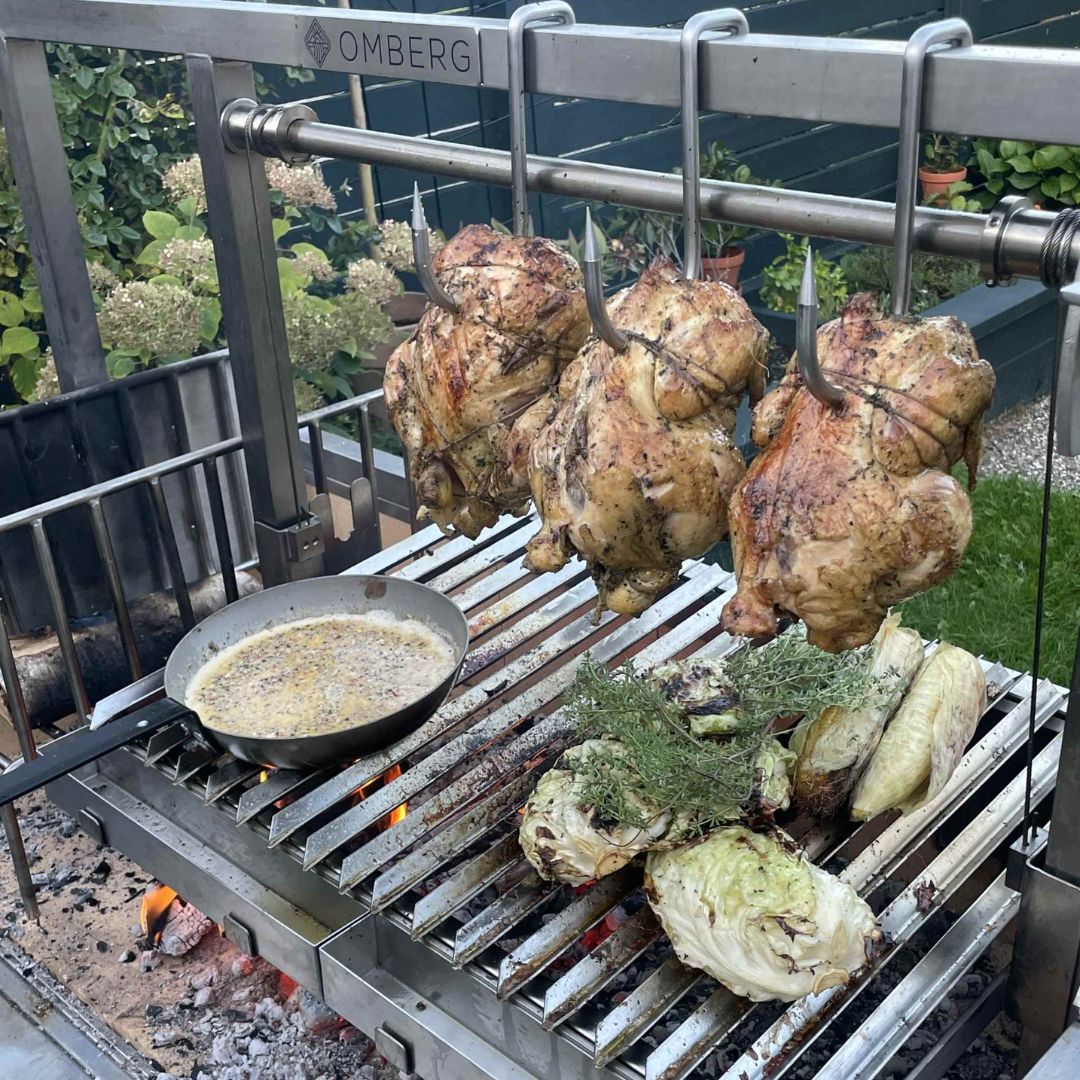
On the Omberg Asado Gaucho 1200, use the height adjustment to set your grates one position above the lowest level. This puts the pork close enough to the coals for a good sear and char without burning the marinade crust before the inside is done.
Target temperature: 200 to 220 degrees Celsius. Hold your hand 15 cm above the grate. You should be able to hold it there for 3 to 4 seconds.
Step 3: Prepare the Steaks
Remove the steaks from the marinade and shake off any excess. Leave some of the onion slices on the meat as they will caramelise on the grill and add flavour. Do not pat the steaks dry. The oil and mustard coating is part of what creates the crust.
Do not season with additional salt at this stage. The marinade has done that work.
Step 4: Grill the Schwenkbraten
Place the steaks on the grate and leave them alone for 4 to 5 minutes. You want the first side to develop a proper char before you move anything. The marinade crust needs heat and time to set.
Use the long-handled tongs from the Omberg BBQ Tool Set to flip the steaks, and cook the second side for another 4 to 5 minutes. The total cook time for a 2 to 3 cm thick pork neck steak at this heat is 10 to 14 minutes, turning once or twice. Do not press the steaks down with a spatula. Pressing forces out the juices the marinade worked to keep inside.
The steaks are done when the internal temperature reaches 68 to 72 degrees Celsius. The outside should be deeply charred and caramelised. The inside should be slightly pink at the very centre, juicy throughout. If you do not have a thermometer, cut into the thickest steak at the 12-minute mark. No raw pink in the centre, juices run clear, meat feels firm but gives slightly when pressed.

Step 5: Rest and Serve
Remove the steaks from the grill and rest them on a wooden board for 5 minutes. Pork neck does not need a long rest like a large beef cut, but those 5 minutes matter. The juices settle and the meat finishes cooking gently from its own residual heat.
Serve whole with bread, potato salad, and mustard. Do not slice Schwenkbraten at the table. Each person gets their own steak to eat as they like.
Pro Tips for Perfect Schwenkbraten
The juniper berries are not optional. They are what make Schwenkbraten taste like Schwenkbraten and not just marinated pork. Crush them lightly with the flat of a knife before adding to the marinade so the oils are released. You can find them in most supermarkets in the spice aisle.
Do not rush the marinade. A 24-hour marinade is the minimum. A 72-hour marinade produces a fundamentally different result. The flavour penetrates deeper, the mustard tenderises the muscle further, and the onion gives the crust a natural sweetness when it hits the fire.
Keep the onion on during the cook. The slices of onion from the marinade that stick to the steaks will char and caramelise on the grate. This is good. Scrape any pieces that burn completely, but most will turn golden and add flavour to the crust.
Do not overcook pork neck. This is the most common mistake. Pork neck is fatty enough to handle a medium-to-medium-well cook. Going past 75 degrees internal temperature starts to dry it out. You want it just past pink in the centre, not grey throughout.
The Omberg Asado Gaucho 1200 handles up to 6 steaks comfortably across its 120 cm surface, which means every steak cooks at the same heat without crowding. Crowded grates steam instead of sear. Space is part of the technique.
After the cook, use the V-Shaped Grill Scraper while the grates are still warm. The sugar from the marinade caramelises onto the grate and is easiest to remove within 10 minutes of finishing the cook.

What to Serve With Schwenkbraten
German potato salad (Kartoffelsalat) is the traditional and correct side dish. The Saarland style uses warm potatoes dressed with broth, vinegar, onion, and mustard. No mayonnaise. The sharpness of the dressing balances the richness of the pork and the sweetness of the caramelised marinade.
Fresh Brötchen or baguette is how most Germans serve it, torn at the table and used to wipe the juices from the board. Simple and right.
Grilled vegetables on the Omberg grate alongside the pork work well for a fuller spread. Thick slices of courgette, whole mushrooms, and halved peppers placed beside the steaks for the last 10 minutes of the cook. Use the wide cooking surface of the Omberg 1200 to run everything at the same time.
Chimichurri as a cross-cultural addition is something worth trying. The fresh herb and garlic sauce from Argentine asado culture works surprisingly well with the juniper and mustard flavours of the Schwenkbraten crust. It connects the two traditions on the plate. (See our chimichurri recipe on the Omberg blog)
Wine and Beer Pairings
Schwenkbraten is a social, relaxed cook. The drinks should match.
Riesling, first choice: A dry or off-dry Riesling Spätlese from the Mosel or the Saar valley is the ideal pairing. The Saar is geographically close to the Saarland where Schwenkbraten originates, making this more than just a flavour match. It is a regional pairing with history behind it. The mineral acidity and stone fruit character of a Mosel Riesling cuts through the fat of the pork neck perfectly. Look for producers like Egon Müller, Dr Loosen, or Joh. Jos. Prüm.
Red wine option: A German Spätburgunder (Pinot Noir) from the Pfalz or Baden region is the right red wine pairing for Schwenkbraten. Light enough not to overpower the pork, with enough earthy character to stand alongside the smoke and juniper crust. Weingut Friedrich Becker from the Pfalz is a particularly good producer.
Argentine option: A Mendoza Malbec works if you want to lean into the South American connection. Choose a lighter, fresher style rather than a heavily oaked one for pork. A Luján de Cuyo Malbec at around 13 to 13.5 percent alcohol is the sweet spot.
Beer, always an option: In the Saarland, Schwenkbraten is always served with cold beer. A German Pils like Bitburger, brewed in the region, or a Kellerbier from a smaller regional brewery. Cold, clean, and refreshing between bites.
The Cultural Story
The gaucho tradition of open-fire cooking across the South American pampas spread further than most people realise. German settlers in southern Brazil in the 1800s watched local cowboys cook entire animals over hardwood fires and brought that knowledge back to Europe with them.
The Schwenkgrill, the swinging iron grill that gives the dish its name, is a direct descendant of the suspended meat cooking of the gaucho tradition. The open fire. The patience. The simple seasoning that respects the quality of the meat. These are not German inventions. They are South American principles that German cooks adopted and made their own.
The Omberg Asado Gaucho 1200 closes that circle. It brings the original South American open-fire design to a German recipe that was born from exactly that tradition. Cooking Schwenkbraten on an Omberg grill is not fusion. It is a homecoming.
FAQ
What cut of pork do I use for Schwenkbraten?
Pork neck, called Nacken or Schweinehals in German, is the traditional and correct cut. It has a high fat content running through the muscle that keeps it moist on a hot fire. Pork shoulder works as a substitute. Avoid pork loin for this recipe as it is too lean and dries out quickly on an open grill.
How long should I marinate Schwenkbraten?
24 hours is the minimum. 48 to 72 hours gives you a noticeably deeper flavour and a better crust on the grill. The mustard in the marinade also gently tenderises the meat over time, so longer is genuinely better here.
Can I cook Schwenkbraten without juniper berries?
Yes, but the flavour will be different. Juniper berries are the ingredient that gives Schwenkbraten its distinctive character. If you cannot find them, a small amount of dried rosemary and an extra pinch of black pepper can substitute in a pinch. Most larger supermarkets in Germany and the Netherlands carry juniper berries in the spice section.
How do I know when the pork is done?
The internal temperature should reach 68 to 72 degrees Celsius. If you do not have a thermometer, cut into the thickest steak after 12 minutes. The meat should be just past pink at the very centre with clear juices. A little pink is fine. Grey throughout means it has cooked too long.
Can I use the Omberg Built-In for this recipe?
Yes. The Asado Gaucho 1200 Built-In is excellent for Schwenkbraten. Set the grates one position above the lowest level for the right cooking height. The 120 cm surface lets you cook 6 steaks at the same time without crowding.
What if I do not have 72 hours to marinate?
Even 4 to 6 hours of marinating makes a meaningful difference. The juniper and mustard flavours need time to penetrate but some is always better than none. If you are cooking same-day, add a little extra mustard to the marinade to compensate.
Your Garden. Their Tradition. Your Fire.
Schwenkbraten started around an open fire in South America. It came to Germany with settlers who understood what fire could do to good meat. Now it comes back to those roots on the Omberg Asado Gaucho 1200.
The 120 cm cooking surface, height-adjustable grates, and open-fire design give you everything this recipe needs. Space, heat control, and the kind of fire that makes pork neck taste like it was always supposed to taste this good.
Shop the Omberg Asado Gaucho 1200 Browse All Omberg Accessories Explore More Asado Recipes