Côte de Boeuf Bordelaise: France's Greatest Steak on the Open Fire
Bordeaux gave the world its finest red wine. It also gave the world the sauce that goes with beef. Both belong on the same table as a fire.
France does not have a grilling culture the way Argentina does. The French have their rôtisserie, their braisière, their four. The oven, the pot, the rotisserie spit. But the côte de boeuf, the great bone-in ribeye of French butchery, has always had a quiet relationship with fire. In the Bordeaux region, where cattle graze on rich pasture alongside the most famous wine appellations in the world, thick bone-in rib steaks have been cooked over vine cuttings for centuries. The wood is aromatic. The fire is direct. The result is something the oven cannot replicate.
Bordelaise sauce is the great French red wine sauce. Shallots, thyme, bay leaf, a serious Bordeaux, and bone marrow finished with butter. It is not a complicated sauce. It is a precise one. Made properly over an open fire in a cast iron pan while the côte de boeuf rests alongside, it carries the smoke of the grill into the sauce itself. This is the version the restaurants do not serve you. This is the one worth making.
The connection between Bordeaux and Argentina runs deeper than most people realise. Malbec, Argentina's defining red grape, originated in Bordeaux. The French brought it to Mendoza in the 19th century where it found the altitude, the sunshine, and the soil it needed to become something magnificent. A Mendoza Malbec alongside a Bordelaise-sauced côte de boeuf on an Argentine parrilla is not fusion. It is a reunion.

Understanding the Cut
Côte de boeuf is the French name for a bone-in ribeye. A thick section of the rib cut left on the bone, typically weighing between 800 g and 1.2 kg for a single portion intended to serve two. It is the same muscle as the whole ribeye block used in the Omberg cornerstone recipe, but cut thick as a single steak rather than cooked as a whole roast.
The bone is not decoration. It insulates the meat alongside it during the cook, producing a band of particularly tender, juicy meat closest to the rib that is unlike any other part of the steak. It also makes the presentation at the table hard to match. A thick bone-in côte de boeuf carried to the table on a wooden board is an event, not just a dish.
In French butcher shops, a good côte de boeuf will be cut to order and dry-aged for a minimum of 3 to 4 weeks. Ask for at least 4 cm thickness. Anything thinner than that and you cannot achieve the combination of a properly developed crust on the outside and a pink, rested interior that this recipe requires. In the Netherlands, ask for "côte de boeuf aan het bot." In Germany, "Kotelett vom Rind am Knochen." Any serious butcher across all four markets will cut it to your specification with 48 hours notice.
Ingredients
Serves: 2 to 3 people per côte de boeuf Prep time: 20 minutes plus overnight dry brine Cook time: 18 to 25 minutes plus rest Difficulty: Intermediate
For the steak:
- 1 côte de boeuf, bone-in, 800 g to 1.2 kg, at least 4 cm thick
- Coarse sea salt, generous
- Freshly cracked black pepper
- 2 tablespoons neutral oil for the grate
For the Bordelaise sauce:
- 2 tablespoons unsalted butter, divided
- 3 shallots, finely minced
- 2 garlic cloves, minced
- 200 ml good Bordeaux or Merlot-based red wine, use something you would drink
- 150 ml good beef stock, reduced if possible
- 2 sprigs fresh thyme
- 1 bay leaf
- 2 tablespoons bone marrow, scooped from a split marrow bone (ask your butcher), or substitute an extra tablespoon of cold butter
- Fine sea salt and white pepper
For the fire:
- Good hardwood charcoal or quebracho wood
- Chimney starter or natural firelighters
To serve:
- Pommes sarladaises or simple roasted potatoes
- Watercress or a simple green salad with Dijon vinaigrette
- A glass of whatever Bordeaux did not go into the sauce
Instructions
Step 1: Dry Brine the Night Before
The night before your cook, pat the côte de boeuf completely dry. Apply a generous, even layer of coarse sea salt on every surface including the bone and the fat cap. Place uncovered on a rack over a tray and refrigerate overnight.
The dry brine does two things. It seasons the interior of the steak rather than just the crust, and it draws surface moisture away from the meat overnight, producing the dry, tacky surface that develops the best possible crust on a hot grate. A wet surface steams before it browns. A dry surface browns immediately. For a cut this thick, the overnight salt is not optional.
Step 2: Come to Temperature
Remove the côte de boeuf from the refrigerator one full hour before cooking. A 1 kg steak needs this time. The difference in cook time and crust quality between a cold-centred steak and one that has genuinely rested at room temperature is significant and immediately visible in the finished result.
Add the cracked black pepper at this stage. The salt went on last night. The pepper goes on now. Added too early, it can taste slightly harsh after a full overnight.
Step 3: Build Your Fire for a Hot Cook
This is not a low-and-slow recipe. A côte de boeuf is a direct heat cook. High temperature, short time, precise attention. You need a fire that is ready to sear at full intensity.
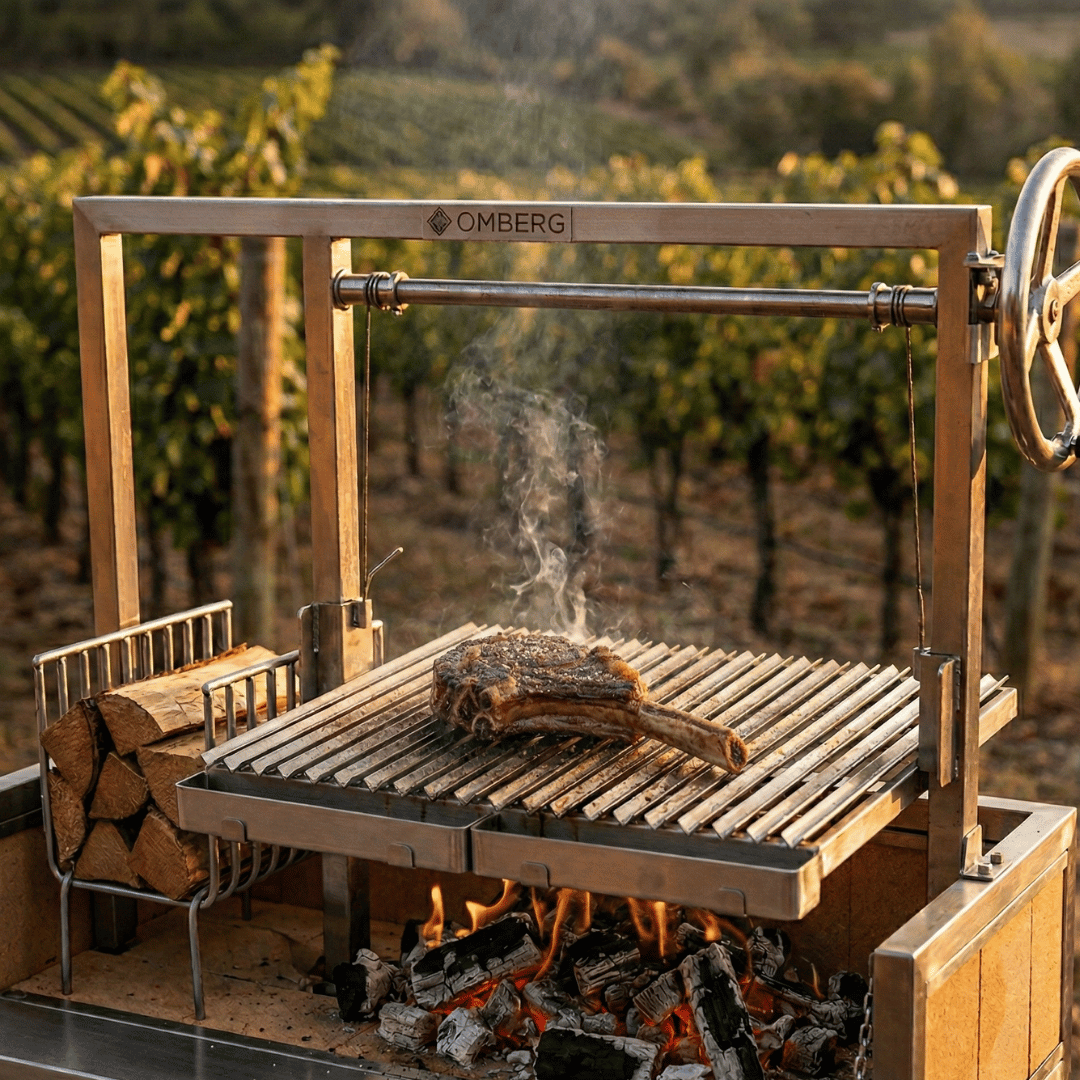
Start your fire 50 to 60 minutes before cooking. Use a chimney starter completely full of good hardwood charcoal. When fully lit and grey, pour the entire load into the base of the Omberg Asado Gaucho 1200 and set the grates at the lowest position. This is the closest position to the fire and it is where you want to be for the initial sear on a steak this thick.
Give the grates 10 minutes to reach full temperature after the coals are in position. Brush the bars clean with the V-Shaped Grill Scraper and oil lightly with a folded cloth dipped in neutral oil. A clean, oiled grate means clean release and good crosshatch marks on the fat cap.
Target temperature: 250 to 280 degrees Celsius at grate height for the sear phase. You should only be able to hold your hand 15 cm above the grate for 1 to 2 seconds.
Step 4: Sear the Fat Cap First
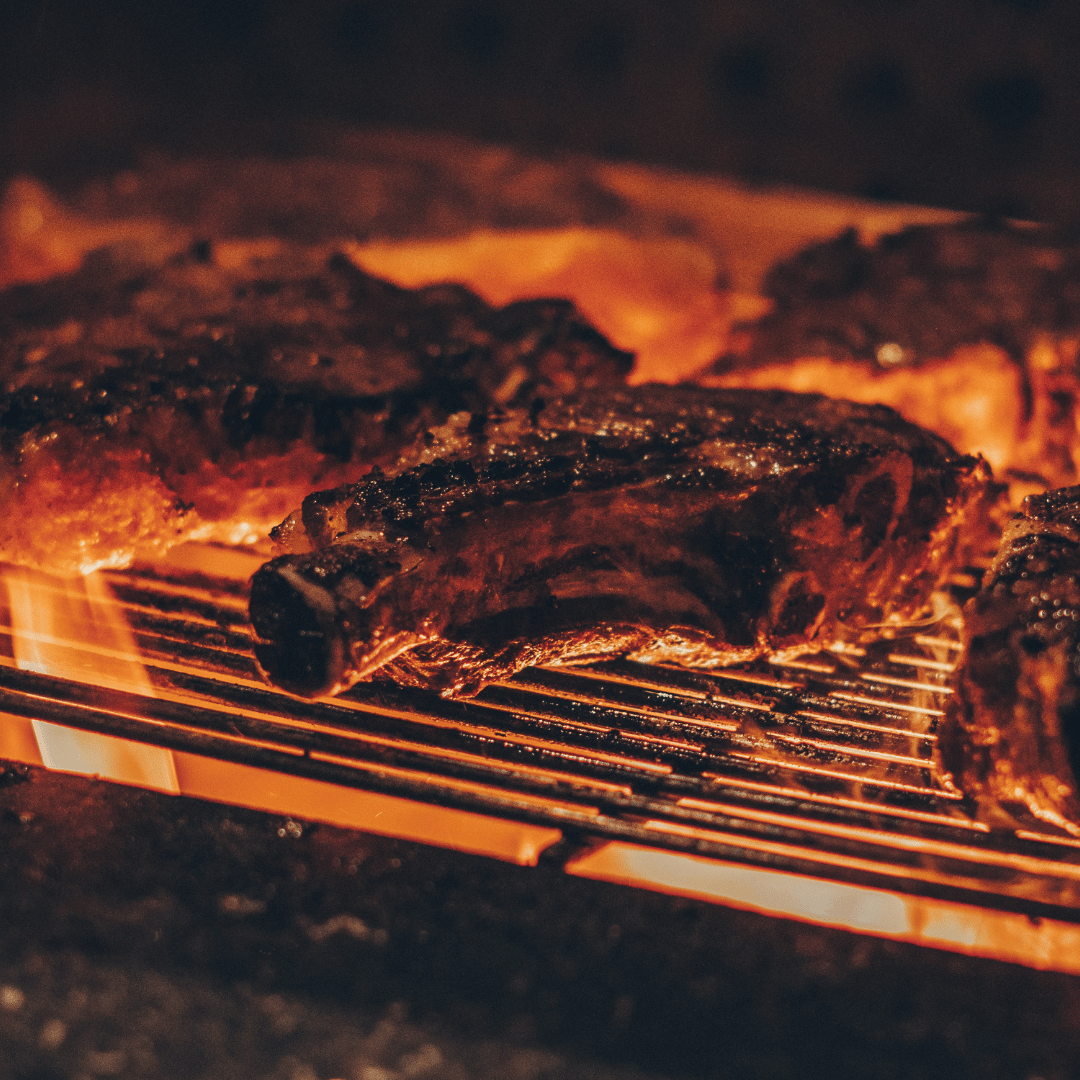
Stand the côte de boeuf on its fat cap edge on the grate, fat side down, balanced upright with the bone as support if needed. Sear the fat cap for 3 to 4 minutes until it renders and crisps. This is a technique borrowed from French restaurant cooking where the fat cap is always rendered before the main faces are seared. The rendered fat then bastes the steak naturally during the rest of the cook.
Step 5: Sear Both Faces
Lay the steak flat on the grate, one cut face down. Do not move it for 3 minutes. After 3 minutes, rotate it 45 degrees on the same side to develop crosshatch marks and cook for another 2 minutes. Flip using the long-handled tongs from the Omberg BBQ Tool Set and repeat on the second face. 3 minutes, rotate 45 degrees, 2 more minutes.
At this point the steak has had approximately 14 minutes of cook time including the fat cap. For a 4 cm thick côte de boeuf targeting medium rare, check the internal temperature. You are looking for 48 to 50 degrees Celsius at the thickest point. This is below the final target of 57 degrees because the steak will climb during the rest period.
If the internal temperature is below 45 degrees, raise the grate one position on the Omberg 1200 to reduce the direct heat and continue cooking, checking every 2 minutes, until the target is reached.

Step 6: Rest the Steak and Make the Bordelaise
This step runs simultaneously. The sauce is made while the steak rests. Neither should wait for the other.
Remove the côte de boeuf from the grate and place it bone side down on a wooden board. Rest uncovered for 10 to 12 minutes. A steak this thick needs the full rest. The internal temperature will climb from 48 to 50 degrees to 57 to 60 degrees during this time, which is full medium rare, without any further cooking needed.
While the steak rests, place the Carbon Steel Griddle on the grate over the remaining coals. Add 1 tablespoon of the butter. When it foams, add the minced shallots and a pinch of salt. Cook for 3 to 4 minutes, stirring, until completely softened and beginning to colour. Add the garlic and cook for 1 further minute.
Pour in the red wine. Add the thyme sprigs and bay leaf. Let the wine reduce by two thirds. This takes approximately 5 to 6 minutes over a fire this hot. Add the beef stock and reduce by half again, another 3 to 4 minutes. The sauce should be glossy and just thick enough to coat the back of a spoon.
Remove from the heat. Add the bone marrow and the remaining tablespoon of cold butter, swirling the pan rather than stirring, until the butter melts into the sauce and gives it its final gloss. Season with salt and white pepper. Remove the thyme and bay leaf. The sauce should be finished at exactly the moment the steak has rested long enough. This is what makes the dish feel precise.
Step 7: Slice and Serve
Slice the côte de boeuf at the table. Cut the meat away from the bone in one piece, then slice across the grain into portions 1.5 to 2 cm thick. Fan the slices back alongside the bone on the board. Spoon the Bordelaise sauce directly over the sliced meat and serve immediately.
Pro Tips for a Perfect Côte de Boeuf Bordelaise
Use a wine you would actually drink in the sauce. The Bordelaise reduces the wine significantly, concentrating every quality it has, including its flaws. A cheap, bitter wine produces a cheap, bitter sauce. A good Merlot-based Bordeaux produces something worth eating. You need 200 ml. That is less than a third of a bottle. Spend accordingly.
The bone marrow is worth asking your butcher for. Split marrow bones are inexpensive and most butchers will include them if you ask when ordering the côte de boeuf. The marrow melts into the Bordelaise and gives it a richness that extra butter alone cannot replicate. If marrow is not available, the extra butter finish still produces an excellent sauce, just a different one.
Sear the fat cap first, always. Standing the steak upright on its fat edge before laying it flat is a small step that makes a large difference. Rendered fat cap on a côte de boeuf produces a golden, crispy edge alongside the meat that is one of the best things about this cut.
Clean grates make better crosshatch marks. Run the V-Shaped Grill Scraper across every bar before you oil and cook. For a cut like this, presentation matters and clean marks on a côte de boeuf tell your guests something about the cook before the first bite.
Make the sauce on the fire, not on the hob. The charcoal smoke that rises through the grate while the Bordelaise reduces adds something to the sauce that no gas flame or electric hob can provide. The open fire is not incidental to this recipe. It is an ingredient.
What to Serve With It
Pommes sarladaises is the traditional accompaniment from southwest France. Thinly sliced potatoes layered with duck fat, garlic, and thyme, cooked until golden and tender. If duck fat is not available, good olive oil and butter produce an excellent result. Start these in a cast iron pan on the edge of the grate 40 minutes before the steak goes on.
Watercress salad with Dijon vinaigrette. The peppery bitterness of watercress is a good match for rich red wine sauce. Keep the dressing simple. Dijon mustard, red wine vinegar, olive oil, salt. Nothing more.
Grilled bread on the grate in the final minutes of the steak rest. Thick slices of a good baguette or pain de campagne, cut side down on the bars for 2 minutes. Use the bread to collect the last of the Bordelaise from the board.
Bone marrow toast if you requested split marrow bones from your butcher. Roast the halved bones cut side up on the edge of the grate for 15 minutes, scoop the marrow onto grilled bread with fleur de sel and a squeeze of lemon. Serve as a starter while the côte de boeuf cooks.
Wine Pairings
The obvious and correct choice: Bordeaux. A Bordeaux from the Médoc appellation, Cabernet Sauvignon dominant, structured, with tannin that the fat of the côte de boeuf will soften beautifully, is the pairing this dish was designed for. Châteaux Léoville-Barton, Gloria, or Sociando-Mallet for something serious. A good generic Médoc or Haut-Médoc for a more everyday occasion. Both are widely available across the Netherlands, Germany, and France.
The Argentine option: Mendoza Malbec. Malbec is a Bordeaux grape. A Mendoza Malbec from Luján de Cuyo or the Uco Valley alongside a Bordelaise sauce is a pairing that tells a complete story in one glass. The dark fruit, the soft tannin, and the structure of a good Argentine Malbec works with this sauce in a way that feels almost designed. Clos de los Siete, Zuccardi Valle de Uco, or Catena Zapata for the prestige version.
For the Burgundy preference: Côte de Nuits. A Gevrey-Chambertin or Nuits-Saint-Georges for guests who prefer Pinot Noir. The earthiness and structure of a good Côte de Nuits village wine sits well alongside beef and bone marrow. More expensive than the Bordeaux options but worth it on the right occasion.
Non-wine option: A good French cidre bouché from Normandy. The traditional sparkling bottled cider is a genuine and underrated pairing for grilled beef in northern French cooking. Refreshing, complex, and completely unexpected. For an afternoon where the point is to surprise your guests, this is a good move.

The Cultural Story
The Bordelaise and the parrilla have never shared a table until now. That is surprising when you look at how much they have in common.
The Bordeaux region built its identity around two things: exceptional cattle and exceptional wine. The Blonde d'Aquitaine and Limousin breeds that graze across the Gironde and Dordogne departments produce some of the finest beef in Europe. The wine appellations surrounding them, Pomerol, Saint-Émilion, Margaux, produce the wines that the world measures all others against. Both the cattle and the wine have been part of the same landscape for centuries.
The Argentine pampas built its identity around exactly the same two things. Exceptional cattle grazing on mineral-rich grass. And the wine. Malbec, brought from Bordeaux in the 1850s by French agronomist Michel Pouget, planted in the high-altitude soil of Mendoza where it became something the French had never managed to produce at home.
The Omberg Asado Gaucho 1200 is the grill that belongs at the intersection of these two traditions. Argentine open-fire engineering. French premium beef. A sauce built from Bordeaux wine made over charcoal on the same grate the steak just came off.
FAQ
What is Bordelaise sauce and how difficult is it to make?
Bordelaise is a classic French red wine sauce built on shallots, thyme, bay leaf, red wine, beef stock, and bone marrow finished with butter. The technique is straightforward. Reduce the wine with aromatics, add stock, reduce again, finish with marrow and butter. Made on the grill while the steak rests, it takes approximately 15 minutes. The most important variable is using a good wine and good stock. The sauce is only as good as its ingredients.
Where do I source bone marrow for the sauce?
Ask your butcher when ordering the côte de boeuf. Request two split marrow bones, halved lengthways, which will give you more than enough marrow for the sauce with some left over to roast as a starter. Marrow bones are inexpensive and butchers almost always have them available with advance notice. If marrow is not available, substitute an additional tablespoon of very cold unsalted butter stirred in at the end.
What internal temperature should a côte de boeuf reach?
Remove the steak from the grill at 48 to 50 degrees Celsius. It will climb to 57 to 60 degrees during the 10 to 12 minute rest, which is medium rare and the correct temperature for a côte de boeuf. Going above 65 degrees starts working against the marbling that makes this cut worth the investment.
Can I make Bordelaise sauce ahead of time?
Yes. Make the sauce up to the point of adding the butter and marrow, then refrigerate. Reheat gently when the steak is resting and add the marrow and butter finish at that point. Do not add the butter finish too far in advance as the emulsion breaks when reheated aggressively.
Can I use the Omberg Built-In 1200 for this recipe?
Yes. The Asado Gaucho 1200 Built-In handles this recipe with no adjustments needed. Set the grates at the lowest position for the initial sear and raise one level if the crust is developing faster than the interior is cooking.
What if I cannot find a genuine Bordeaux for the sauce?
Any good Merlot-dominant red wine works well. A Merlot from Saint-Émilion, Pomerol, or Fronsac is the closest substitute. An Argentine Malbec is also a good option and fits the cultural story of the article. It produces a sauce with slightly more dark fruit character than a classic Bordeaux. Avoid very tannic Cabernet Sauvignon-dominant wines as the tannins can turn bitter during the reduction.
France Meets Argentina. One Fire, One Board.
The côte de boeuf is the best steak France produces. The Bordelaise is the best sauce France makes for beef. The Omberg Asado Gaucho 1200 is the grill that makes both of them better than any kitchen could.
120 cm of cooking surface. Height-adjustable grates from sear to sauce. Open fire that goes into the food, not around it.
Shop the Omberg Asado Gaucho 1200 Browse All Omberg Accessories Explore More Asado Recipes